German Translation
AI translation is pretty amazing these days. AI tooling is pretty great too. I host my websites on GitHub Pages and I have a ChatGPT subscription. ChatGPT co...
Im ersten Beitrag war AI FX noch kaum mehr als ein Samen: ein Repository, ein PyPI-Paket und die Idee, automatisierte Devisenhandelswerkzeuge als Lernlabor zu verwenden. Inzwischen hat dieser Samen Wurzeln geschlagen. Das Projekt hat eine funktionierende Broker-Client-Architektur. Live-Daten von OANDA fließen in eine In-Memory-Datenbank, werden über ZeroMQ veröffentlicht und von einer Qt-Oberfläche als Echtzeit-Kerzenchart dargestellt. Es ist noch früh, aber AI FX ist nicht mehr nur ein Gerüst. Es läuft.
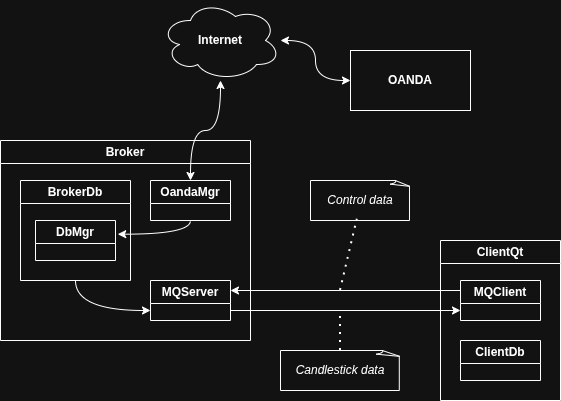
Die aktuelle Architektur besteht aus drei Teilen:
Der Broker ist der Mittelpunkt. Er ruft Marktdaten von OANDA ab, speichert Kurskerzen in einer SQLite-Datenbank im Arbeitsspeicher und verteilt Aktualisierungen über ZeroMQ.
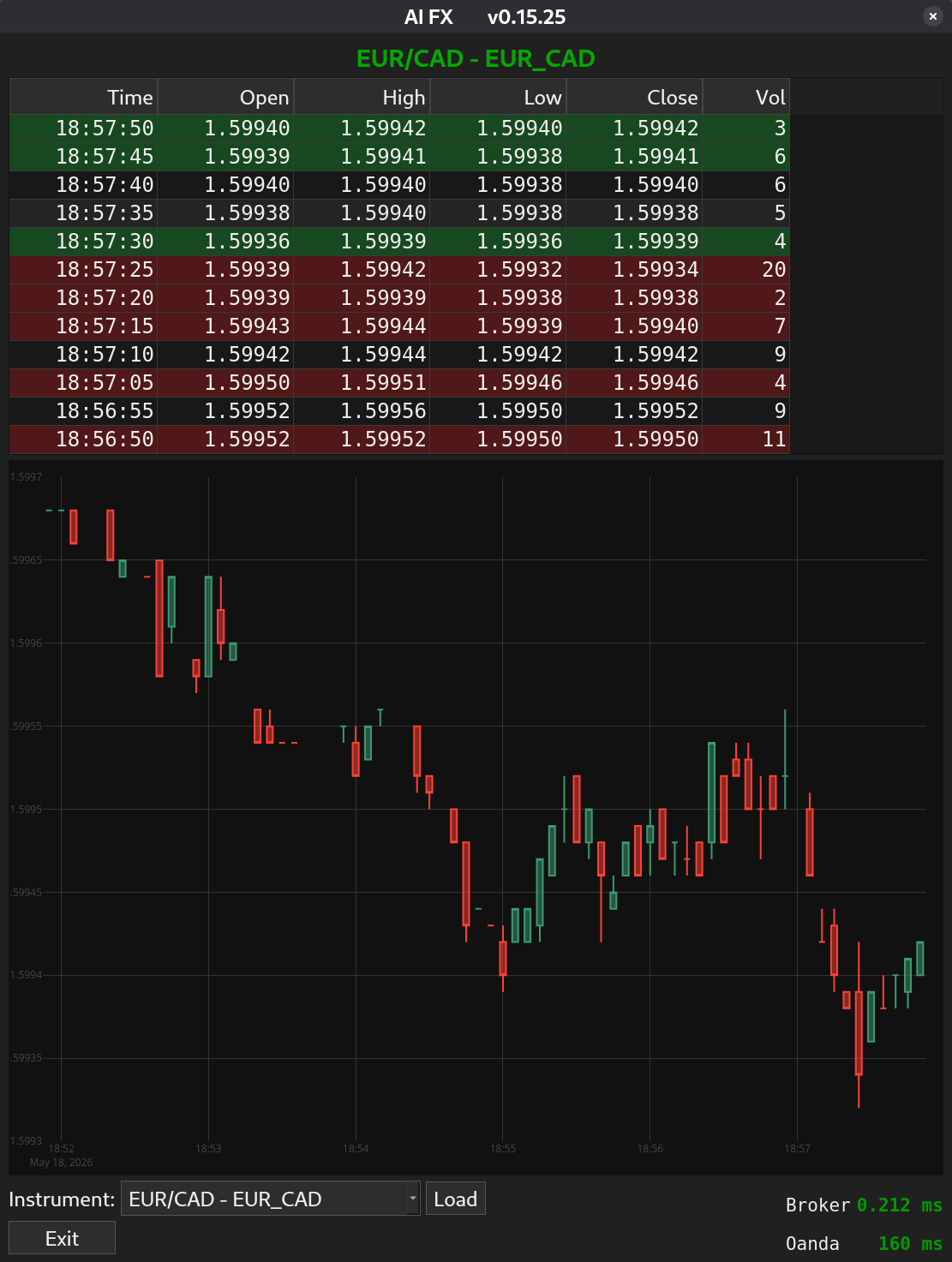
Der Qt-Client verbindet sich mit dem Broker, abonniert ein Thema für Kurskerzen und aktualisiert die Oberfläche bei neuen Daten. So entsteht eine kleine Live-Marktkonsole: aktuelle Kerzen als Tabelle, darunter ein Kerzenchart, Auswahl des Instruments sowie Latenzen für Broker und OANDA.
Das ist wichtig. Es geht nicht bloß darum, ein Diagramm zu bewegen. Ich möchte ein System, das sich selbst beobachten kann.
Ich wollte vermeiden, dass die grafische Oberfläche zur eigentlichen Handelsplattform wird.
Eine GUI eignet sich für Auswahl, Darstellung, Größenänderung, Tabellen, Charts und Schaltflächen. Aber dort sollte nicht der Datenstrom verwaltet werden.
Der Broker sorgt für eine klare Trennung:
Diese Trennung zahlt sich aus. Der Qt-Client kann die Verbindung verlieren und wiederherstellen, ohne zur Quelle der Wahrheit zu werden. Der Broker macht Broker-Sachen. Die GUI macht GUI-Sachen.
Der neueste Meilenstein ist die Qt-Oberfläche. Ursprünglich wollte ich Textual verwenden, aber nachdem ich die Kerzencharts von Plotly gesehen hatte, wollte ich unbedingt diese einsetzen.
Der AIFX-Client verwendet Qt for Python, stellt Plotly-Diagramme in QtWebEngineCore dar und …
Beim Start sind historische Kerzen bereits geladen. Der Bildschirm bleibt also nicht leer, während neue Daten eintreffen. Der Instrumentenwechsel funktioniert, die Tabelle wird aktualisiert, ebenso der Chart. Statusanzeigen zeigen die Verzögerung beim Broker und bei OANDA-Aufrufen.
Das klingt kosmetisch, verändert aber das gesamte Gefühl.
Ein Konsolenlog sagt, die Maschine lebt. Ein Live-Chart macht es sichtbar.
Und Fehler lassen sich schneller erkennen: fehlende Kerzen, veraltete Abonnements, Latenzspitzen, Formatierungsprobleme oder Besonderheiten beim Timing werden offensichtlich. Diese GUI ist nicht nur hübsch, sondern ein Diagnosecockpit.
Aktuell konzentriert sich AI FX auf Fünf-Sekunden-Kerzen.
Dieses Intervall ist kurz genug, damit sich die Anwendung lebendig anfühlt, aber klar genug strukturiert, um mit diskreten Daten zu arbeiten. Jede Kerze fasst einen winzigen Zeitraum zusammen: Eröffnung, Höchstkurs, Tiefstkurs, Schlusskurs, Volumen und Zeitstempel.
Noch ist das Projekt in der Infrastrukturphase. Ich behaupte nicht, dass das System schon handelstauglich ist. Jetzt werden erst die Grundlagen geschaffen:
Die Handelslogik kommt später. Zuerst müssen Leitungen und Rohre liegen.
Erstaunlich viel Fortschritt stammt aus den wenig glamourösen Teilen.
Inzwischen gibt es Unit-Tests für zentrale Datenklassen wie Instrumente und Kurskerzen. Außerdem existieren ein Release-Prozess, Linting- und Typprüfungen sowie ein Smoke-Test für frische Installationen außerhalb des Entwicklungsverzeichnisses.
Das ist wichtig, weil ein solches Projekt schnell zu einem Aquarium voller Spaghetti werden kann.
Marktdaten, Netzwerkkommunikation, asynchrone Schleifen, GUI-Ereignisse, Serialisierung, Diagramme, Paketierung und API-Aufrufe wollen sich alle miteinander verknoten. Tests und Release-Disziplin sind kleine Zäune, die die Ziegen aus dem Serverraum halten.
AI FX ist weiterhin eine kleine Maschine.
Keine institutionelle Handelsplattform, kein magischer Geldautomat. Es versucht nicht, Server direkt neben Börsen zu überholen oder die Latenz von Privatanlegern wegzudiskutieren.
Aber es entwickelt sich zu einem nützlichen Labor.
Die Idee war von Anfang an, etwas zu bauen, das klein genug zum Verstehen und flexibel genug zum Experimentieren ist. Das ist weiterhin das Ziel.
Der Samen steckt nicht mehr einfach nur im Boden.
Jetzt gibt es ein Signal.
AI translation is pretty amazing these days. AI tooling is pretty great too. I host my websites on GitHub Pages and I have a ChatGPT subscription. ChatGPT co...
I noticed a couple of Ukrainian visitors to my websites! YAY!!! How exciting! :)
My little basement aquaponics setup has given me another miniature rose!!!
Some of you may have read my Git Battles post, where I talked about how I developed and a documented a Git workflow.
I recently built MyCount to track website visitors to my projects. I found that that over 40% of my visitors were from China, and that 35% of those used a Ch...
I have a future project in mind which will require a Dynamic DNS service. I created BMDynIP for that purpose. After building the service, I wanted a simple a...
I run an NFS server on my network. I use two large drives and a cron job to rsync the data to provide basic data protection. This solution will not save you ...
I’ve been tinkering with various incarnations of Patrick Loeber’s Train an AI to Play Snake tutorial for a while now. It’s my relaxing goto project that’s fu...
This project started as a cron job and a flatfile and -honestly- that would work perfectly well for a small home setup. Say, two or three machines. I’m curre...
The Bear & Moose GeoIP Project provides an easy-to-use GeoIP service for your applications and for interactive lookups.
Our first TV was a small black-and-white thing where, on rare occasions, we’d watch Animal Kingdom. Then Beta and VHS came along, and you could watch them at...
Fr3d worked: It could talk to the Snake Lab, propose changes to the RNN configuration, run experiments, look at the results, and try again. It proved the ide...
The Snake Lab had become a proper server, with a ZeroMQ API, configuration validation, a database, and a way to run experiments independently of the client. ...
In my last post, I setup a locally hosted LLM running on an old HP Z440 and wrote a crude little conversation loop. I generated random numbers, fed them to t...
This is part one of a four part blog series. In this post, I download, install and setup some software to prompt a local LLM to write haikus…
In the first post, AI FX was still mostly a seed: a repo, a PyPI package, and an idea about using automated FOREX tooling as a learning lab. Since then, the ...
A potential client pointed me to Empowering the Energy Transition Through Fast and Flexible Network Simulation. The article describes an Open Source project,...
I have a prospective client who runs a small group of technology businesses, at least one of which integrates with clients using the Delphi programming lan...
I’ve spent some time around trading systemsL At Merrill Lynch, I supported the Order Audit Trail System (OATS), a compliance system required by NASDAQ. Its p...
A Rosebud, a Few Guppies, and a Quiet Little Ecosystem
I setup an Etsy Storefront to sell high quality, museum grade prints of some of my artwork.
I’ve been working on Db4E, my Monero deployment, operations and analytics platform. It uses Linux systemd to spin up manage Monero, P2Pool and XMRig instance...
AI Snake Lab is an interactive reinforcement learning sandbox for experimenting with AI agents in a classic Snake Game environment — featuring a live Textual...
You know that saying, “A picture is worth a thousand words.”? In programming, I’d argue it can be worth a thousand lines of code…
This post is about using constants in your code. Why it matters, what the benefits are and how you can do it well. I’m sad to say, I learned this the hard wa...
This week, I introduced 15 raccoon tiger shrimp—plus a surprise 2 bonus—to my aquarium. After a proper acclimatization, I released them into the tank… and ju...
When I first started experimenting with Monero mining and self-hosted infrastructure, I did what everyone else does: I downloaded the Monero software, the P2...
Let me be honest: Git has punched me in the face more times than I can count. Every time I think I’ve got a smooth release flow down, Git yells, “Not so fast...
I was burned by opaque documentation: I’ve been building a modern terminal UI in Python using the excellent Textual framework. It’s sharp, fast, and honestly...
The original reporting system was a set of static dashboards built using GitHub Pages, JavaScript, and ApexCharts. It pulled data from my mining setup — via ...
I’ve been deep in the trenches with my Db4E project — pulling together Monero mining infrastructure, MongoDB integration, and a bunch of orchestration magic....
I recently published a small Python module to PyPI and GitHub: db4e-systemd, a lightweight wrapper around systemctl that lets you control services (start, st...
I received my order from NIKU Farms, YAY! It’s a meat delivery that my sister, Corinna Ghaznavi, gifted me this Christmas. Every two months I receive this am...
As part of my goal to be more visible in the world, I setup this domain i.e. https://osoyalce.com. I use it to publish information about the projects I’m wor...
It’s been a while since I started and then abandoned this blog. My last post was in June of 2024!!
I decided that I didn’t like the way that the main blog page looks. I am using GitHub to host the website and am using a fork of the jekyll/minima theme. My ...
It’s in the construction phase. I need to complete the water circulation process. I bought a fiber glass kit for this (and also to fix my kitchen sink!).
The XMR Mining Farm complete with this eye-popping chart The Bear and Moose Knowledge Base My resume MyZODB - A Place to Store Everything