Animating Ax3l Playing Snake
I’ve been tinkering with various incarnations of Patrick Loeber’s Train an AI to Play Snake tutorial for a while now. It’s my relaxing goto project that’s fu...
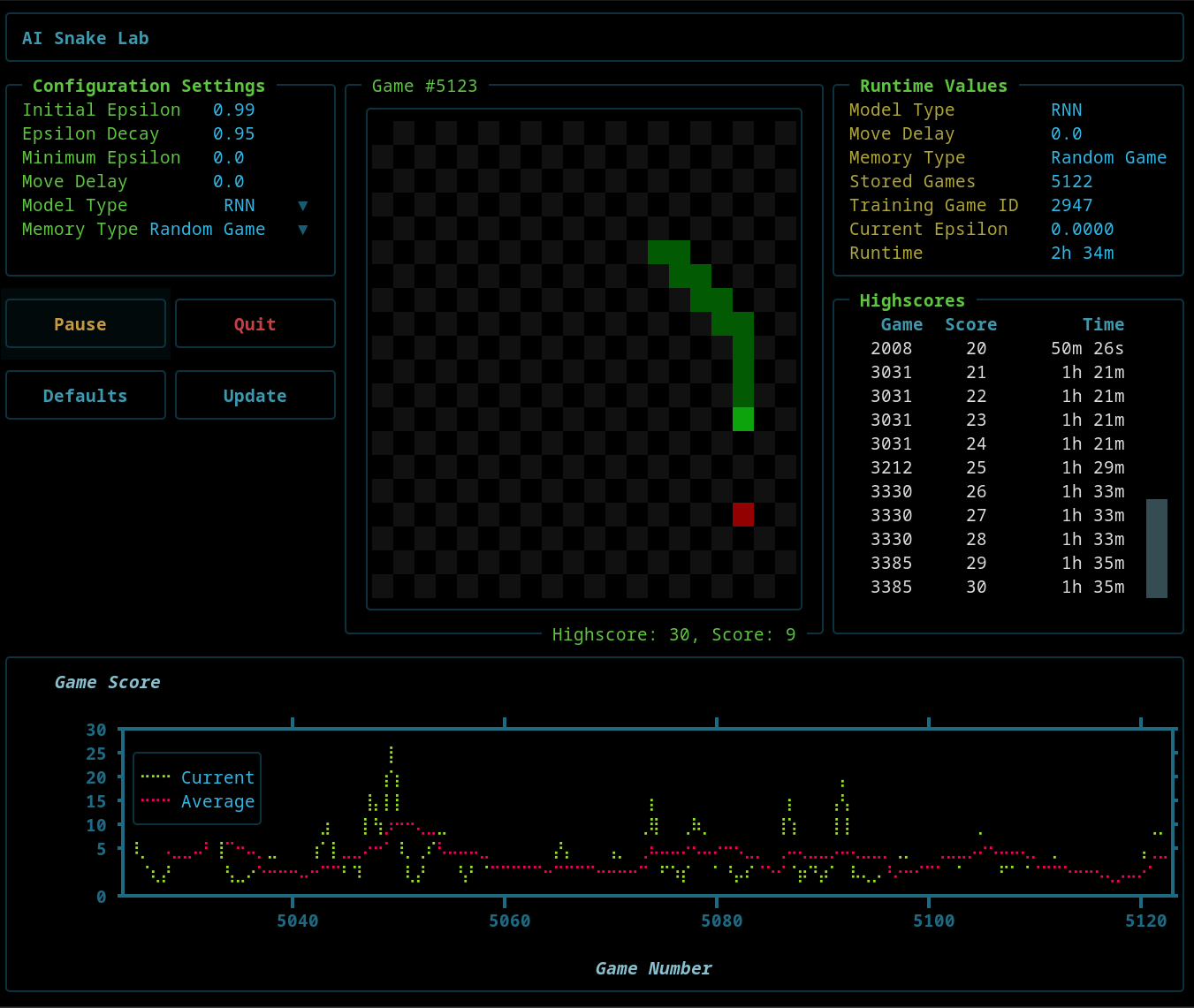
AI Snake Lab is an interactive reinforcement learning sandbox for experimenting with AI agents in a classic Snake Game environment — featuring a live Textual TUI interface, flexible replay memory database, and modular model definitions.
| Component | Description |
|---|---|
| Python 3.11+ | Core language |
| Textual | Terminal UI framework |
| SQLite3 | Lightweight replay memory + experiment store |
| PyTorch (optional) | Deep learning backend for models |
| Plotext / Matplotlib | Visualization tools |
The Dynamic Training checkbox implements an increasing amount of long training that is executed at the end of each epoch. The AIAgent:train_long_memory() code is run an increasing number of times at the end of each epoch as the total number of epochs increases to a maximum of MAX_ADAPTIVE_TRAINING_LOOPS, which is currently 16 according to the calculation shown below:
    if self.dynamic_training():
        loops = max(
            1, min(self.epoch() // 250, DAIAgent.MAX_DYNAMIC_TRAINING_LOOPS)
        )
    else:
        loops = 1

    while loops > 0:
        loops -= 1
        self.train_long_memory()
The Epsilon N class, inspired by Richard Sutton’s The Bitter Lesson, is a drop-in replacement for the traditional Epsilon Greedy algorithm. It instantiates a traditional Epsilon Greedy instance for each score. For example, when the AI has a score of 7, an Epsilon Greedy instance at self._epsilons[7] is used.
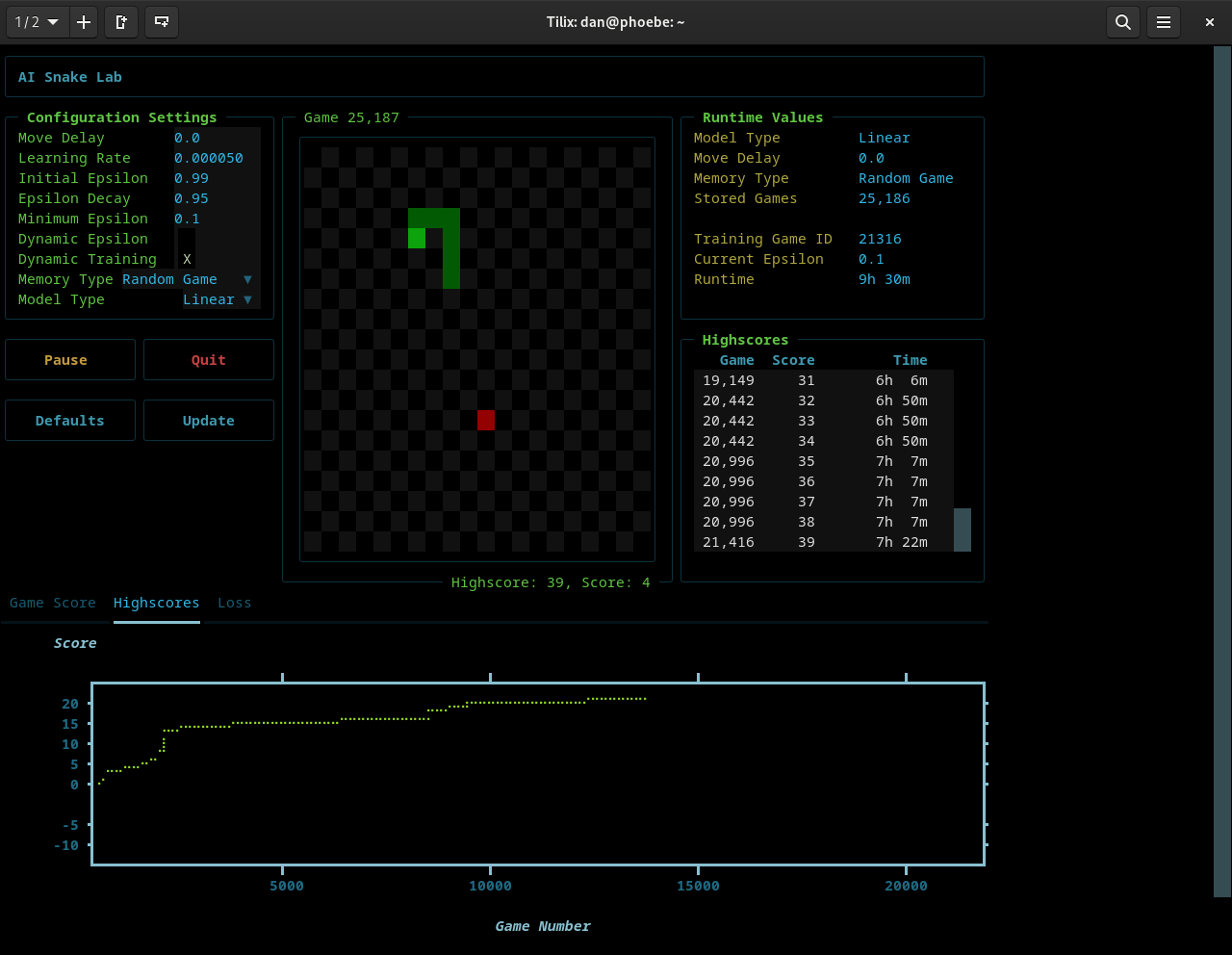
The screenshot below shows the Highscores plot with the traditional, single instance Epsilon Greedy algorithm and with Dynamic Training enabled. The single-instance epsilon algorithm quickly converges but shows uneven progress. The abrupt jumps in the high score line indicate that exploration declines before the AI fully masters each stage of play.
The next screenshot shows the Highscores plot without Dynamic Training enabled and with the Epsilon N being used. By maintaining a separate epsilon for each score level, Epsilon N sustains exploration locally. This results in a smoother, more linear high-score curve as the AI consolidates learning at each stage before progressing.
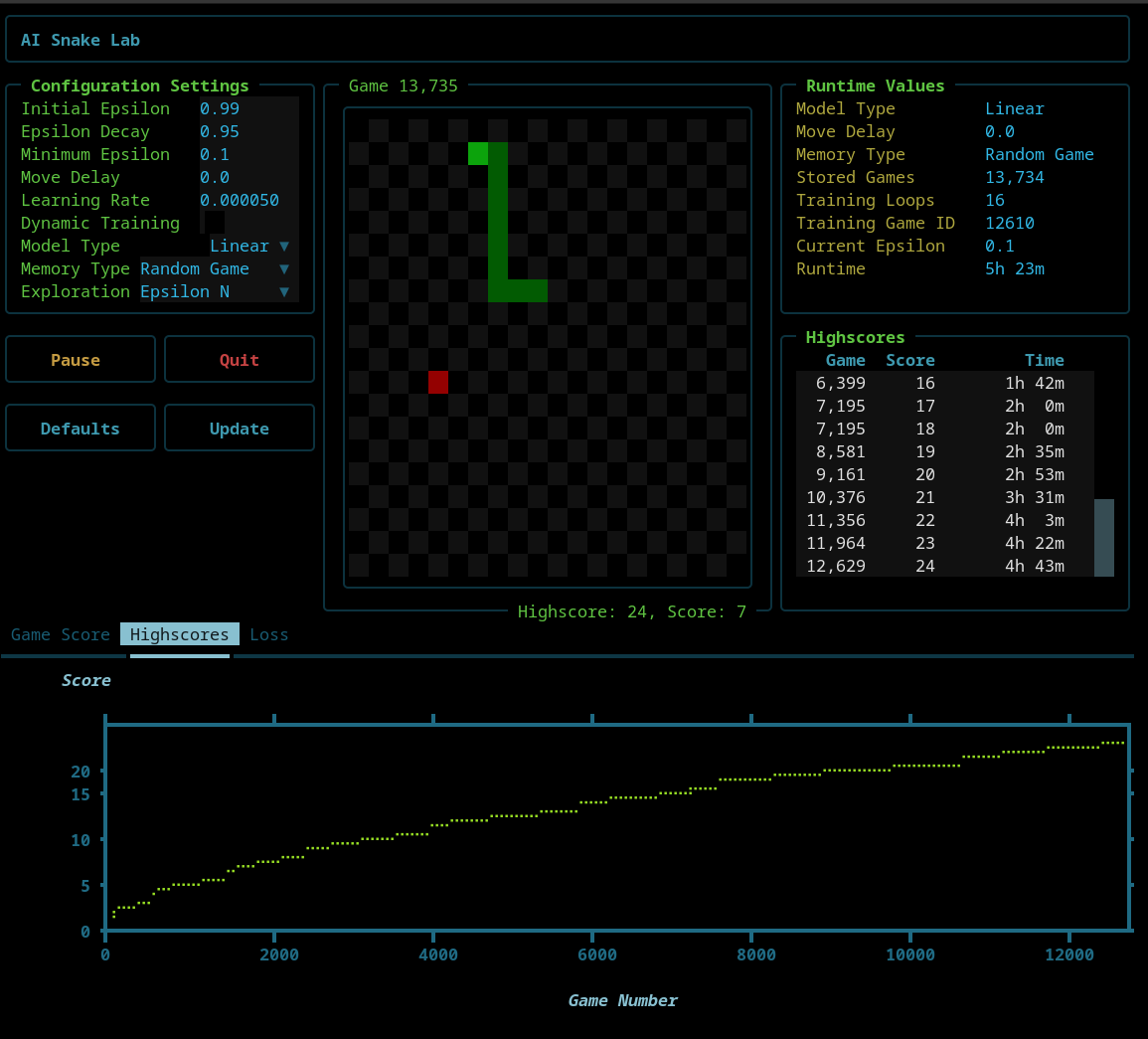
As shown above, the traditional Epsilon Greedy approach leads to slower improvement, with the highscore curve flattening early. By contrast, Epsilon N maintains steady progress as the AI masters each score level independently.
This project is on PyPI. You can install the AI Snake Lab software using pip.
python3 -m venv snake_venv
. snake_venv/bin/activate
After you have activated your venv environment:
pip install ai-snake-lab
From within your venv environment:
ai-snake-lab
Because the simulation runs in a Textual TUI, terminal resizing and plot redraws can subtly affect the simulation timing. As a result, highscore achievements may appear at slightly different game numbers across runs. This behavior is expected and does not indicate a bug in the AI logic.
If you have a requirement to make simulation runs repeatable, drop me a note and I can implement a headless mode where the simulation runs in a separate process outside of Textual.
The original code for this project was based on a YouTube tutorial, Python + PyTorch + Pygame Reinforcement Learning – Train an AI to Play Snake by Patrick Loeber. You can access his original code here on GitHub. Thank you Patrick!!! You are amazing!!!! This project is a port of the pygame and matplotlib solution.
Thanks also go out to Will McGugan and the Textual team. Textual is an amazing framework. Talk about Rapid Application Development. Porting this from a Pygame and MatPlotLib solution to Textual took less than a day.
Creating an artificial intelligence agent, letting it loose and watching how it performs is an amazing process. It’s not unlike having children, except on a much, much, much smaller scale, at least today! Watching the AI driven Snake Game is mesmerizing. I’m constantly thinking of ways I could improve it. I credit Patrick Loeber for giving me a fun project to explore the AI space.
Much of my career has been as a Linux Systems administrator. My comfort zone is on the command line. I’ve never worked as a programmer and certainly not as a front end developer. Textual, as a framework for building rich Terminal User Interfaces is exactly my speed and when I saw Dolphie, I was blown away. Built-in, real-time plots of MySQL metrics: Amazing!
Richard S. Sutton is also an inspiration to me. His thoughts on Reinforcement Learning are a slow motion revolution. His criticisms of the existing AI landscape with it’s focus on engineering a specific AI to do a specific task and then considering the job done is spot on. His vision for an AI agent that does continuous, non-linear learning remains the next frontier on the path to General Artificial Intelligence.
I’ve been tinkering with various incarnations of Patrick Loeber’s Train an AI to Play Snake tutorial for a while now. It’s my relaxing goto project that’s fu...
This project started as a cron job and a flatfile and -honestly- that would work perfectly well for a small home setup. Say, two or three machines. I’m curre...
The Bear & Moose GeoIP Project provides an easy-to-use GeoIP service for your applications and for interactive lookups.
Our first TV was a small black-and-white thing where, on rare occasions, we’d watch Animal Kingdom. Then Beta and VHS came along, and you could watch them at...
Fr3d worked: It could talk to the Snake Lab, propose changes to the RNN configuration, run experiments, look at the results, and try again. It proved the ide...
The Snake Lab had become a proper server, with a ZeroMQ API, configuration validation, a database, and a way to run experiments independently of the client. ...
In my last post, I setup a locally hosted LLM running on an old HP Z440 and wrote a crude little conversation loop. I generated random numbers, fed them to t...
This is part one of a four part blog series. In this post, I download, install and setup some software to prompt a local LLM to write haikus…
In the first post, AI FX was still mostly a seed: a repo, a PyPI package, and an idea about using automated FOREX tooling as a learning lab. Since then, the ...
A potential client pointed me to Empowering the Energy Transition Through Fast and Flexible Network Simulation. The article describes an Open Source project,...
I have a prospective client who runs a small group of technology businesses, at least one of which integrates with clients using the Delphi programming lan...
I’ve spent some time around trading systemsL At Merrill Lynch, I supported the Order Audit Trail System (OATS), a compliance system required by NASDAQ. Its p...
A Rosebud, a Few Guppies, and a Quiet Little Ecosystem
I setup an Etsy Storefront to sell high quality, museum grade prints of some of my artwork.
I’ve been working on Db4E, my Monero deployment, operations and analytics platform. It uses Linux systemd to spin up manage Monero, P2Pool and XMRig instance...
AI Snake Lab is an interactive reinforcement learning sandbox for experimenting with AI agents in a classic Snake Game environment — featuring a live Textual...
You know that saying, “A picture is worth a thousand words.”? In programming, I’d argue it can be worth a thousand lines of code…
This post is about using constants in your code. Why it matters, what the benefits are and how you can do it well. I’m sad to say, I learned this the hard wa...
This week, I introduced 15 raccoon tiger shrimp—plus a surprise 2 bonus—to my aquarium. After a proper acclimatization, I released them into the tank… and ju...
When I first started experimenting with Monero mining and self-hosted infrastructure, I did what everyone else does: I downloaded the Monero software, the P2...
Let me be honest: Git has punched me in the face more times than I can count. Every time I think I’ve got a smooth release flow down, Git yells, “Not so fast...
I was burned by opaque documentation: I’ve been building a modern terminal UI in Python using the excellent Textual framework. It’s sharp, fast, and honestly...
The original reporting system was a set of static dashboards built using GitHub Pages, JavaScript, and ApexCharts. It pulled data from my mining setup — via ...
I’ve been deep in the trenches with my Db4E project — pulling together Monero mining infrastructure, MongoDB integration, and a bunch of orchestration magic....
I recently published a small Python module to PyPI and GitHub: db4e-systemd, a lightweight wrapper around systemctl that lets you control services (start, st...
I received my order from NIKU Farms, YAY! It’s a meat delivery that my sister, Corinna Ghaznavi, gifted me this Christmas. Every two months I receive this am...
As part of my goal to be more visible in the world, I setup this domain i.e. https://osoyalc.com. I use it to publish information about the projects I’m work...
It’s been a while since I started and then abandoned this blog. My last post was in June of 2024!!
I decided that I didn’t like the way that the main blog page looks. I am using GitHub to host the website and am using a fork of the jekyll/minima theme. My ...
It’s in the construction phase. I need to complete the water circulation process. I bought a fiber glass kit for this (and also to fix my kitchen sink!).
The XMR Mining Farm complete with this eye-popping chart The Bear and Moose Knowledge Base My resume MyZODB - A Place to Store Everything